A chatbot waits for a question. An operating system coordinates resources, remembers state, applies rules, and runs work through repeatable interfaces.
Hermes Agent sits much closer to the second model.
That distinction matters because people often evaluate agents by asking, “Which model does it use?” The model is important, but it is only one component. The bigger question is whether the system around the model can reliably connect context, tools, memory, permissions, and verification.
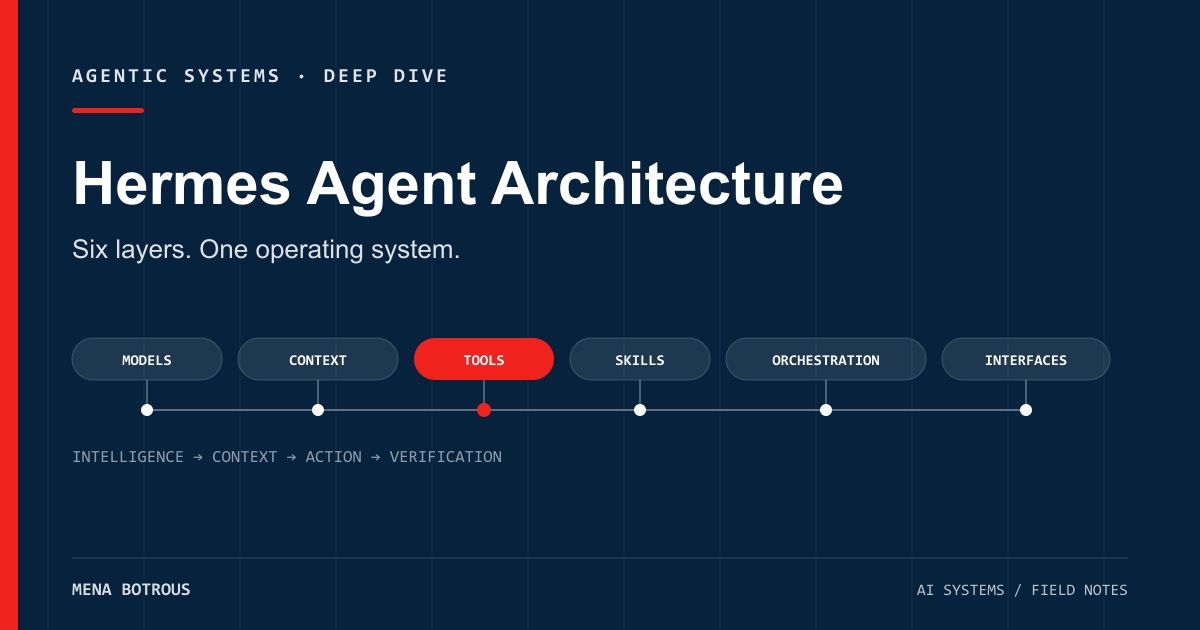
This is the architecture map I use to reason about Hermes.
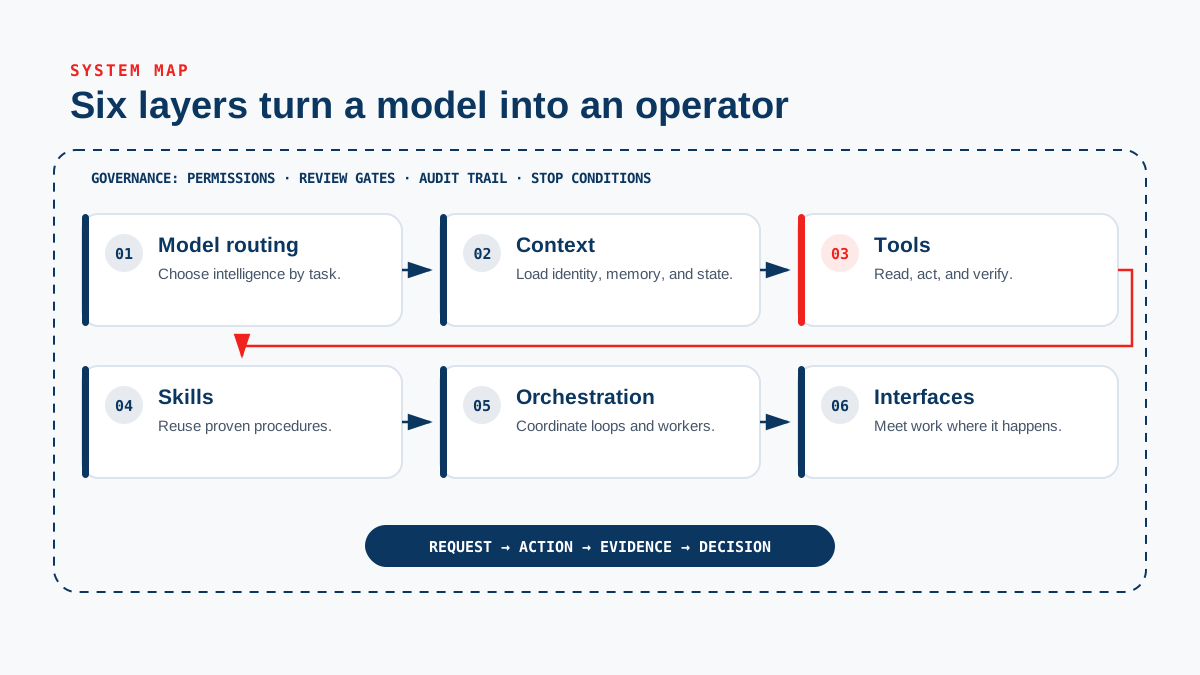
The six layers
| Layer | What it controls | Why it matters |
|---|---|---|
| Model routing | Which provider and model handles the task | Workloads can use different cost, speed, and reasoning profiles |
| Context | Project rules, conversation state, and user preferences | The agent starts with the right constraints instead of rediscovering them |
| Tools | Files, terminals, browsers, APIs, and other actions | The system can inspect and change the real environment |
| Skills | Reusable procedures loaded when relevant | Proven workflows become repeatable rather than prompt folklore |
| Orchestration | Delegation, schedules, webhooks, and profiles | Work can continue across tasks, channels, and specialized agents |
| Interfaces | Terminal, desktop, dashboard, IDE, and messaging | The same operating logic can meet people where work already happens |
A model can produce an answer without these layers. It cannot run a dependable operation without them.
1. Model routing: intelligence is replaceable
Hermes is provider-agnostic. That is not a cosmetic feature. It prevents the operating layer from being welded to one vendor’s model catalog or authentication method.
The practical consequence is separation of concerns:
- the model supplies reasoning and generation;
- the provider supplies access, limits, and billing;
- the agent harness supplies tools, context, state, and execution rules.
This makes model choice a routing decision rather than an architectural rewrite. A fast model can handle routine extraction. A stronger reasoning model can handle design or debugging. A provider outage does not have to erase the rest of the system.
The starting commands are intentionally simple:
hermes model
hermes status --all
hermes doctor
The important habit is not switching models constantly. It is measuring which class of work deserves which model.
2. Context: the difference between a capable stranger and an operator
An unconfigured agent is a capable stranger. It can reason, but it does not know the environment, conventions, or decisions that make its work useful.
Hermes can assemble context from several places:
- the current conversation and resumable sessions;
- project files such as
AGENTS.md; - persistent user and factual memory;
- skills loaded for the task;
- a selected profile with isolated configuration.
These sources should not be treated as one giant prompt. Each has a job.
Project-specific rules belong with the project. Stable user preferences belong in memory. A multi-step publishing method belongs in a skill. Temporary progress belongs in the active session.
Good context architecture reduces repeated steering without turning every task into a wall of instructions.
3. Tools: answers become evidence-backed actions
Tools are the bridge between language and the real environment. Hermes can expose toolsets for files, terminals, web research, browsers, code execution, media, memory, scheduling, and integrations.
The tool layer changes the definition of “done.”
Without tools, an agent may say a build should pass. With tools, it can run the build and report the actual exit code. Without a browser, it may describe how a page should look. With browser and vision tools, it can inspect the rendered result.
A safe tool workflow follows four steps:
- discover the current state;
- make the narrowest useful change;
- execute the real validation;
- inspect the result before reporting success.
That sequence is more valuable than a longer prompt.
Useful discovery commands include:
hermes tools list
hermes mcp list
hermes mcp test <server-name>
MCP servers extend the available actions. They should still be treated as capabilities with permissions and failure modes, not as magic connectors.
4. Skills: operational knowledge that compounds
A good skill is a reusable procedure, not a bag of tips.
It explains when to trigger the workflow, which tools to use, the order of operations, the quality gates, and the common failure modes. That structure lets the agent reuse a method without forcing every detail into the always-loaded system prompt.
For a blog workflow, separate skills might cover:
- research and evidence collection;
- drafting against a content contract;
- SEO and structured-data checks;
- editorial review;
- preview deployment and release.
This modularity matters. A short command reference should not pay the context cost of an entire long-form research manual. The relevant skill should load when needed.
Skills are where a one-time solution becomes an operating asset.
5. Orchestration: one agent is not one process
Hermes supports several ways to extend work beyond a single foreground conversation:
- delegation for independent subtasks;
- profiles for isolated roles and configurations;
- cron jobs for scheduled work;
- webhooks for event-driven runs;
- gateways for execution through messaging platforms.
These mechanisms solve different problems.
Delegation is useful when research, review, and implementation can run independently. Profiles are useful when roles need distinct memory or tools. Cron is useful when the trigger is time. Webhooks are useful when the trigger is an external event.
The mistake is to use orchestration as a substitute for a clear definition of done. Five agents with weak checks produce five streams of uncertainty.
6. Interfaces: the system follows the work
Hermes can run through a terminal, desktop application, dashboard, IDE protocol, or messaging gateway. The interface changes how a person interacts with the agent; it does not need to replace the underlying operating model.
That gives a business owner a useful progression:
- start interactively in the desktop or terminal;
- formalize repeated work as a skill;
- add a safe integration or scheduled trigger;
- separate mature workloads into profiles;
- retain approval gates for external or irreversible actions.
Automation should follow a proven workflow, not precede it.
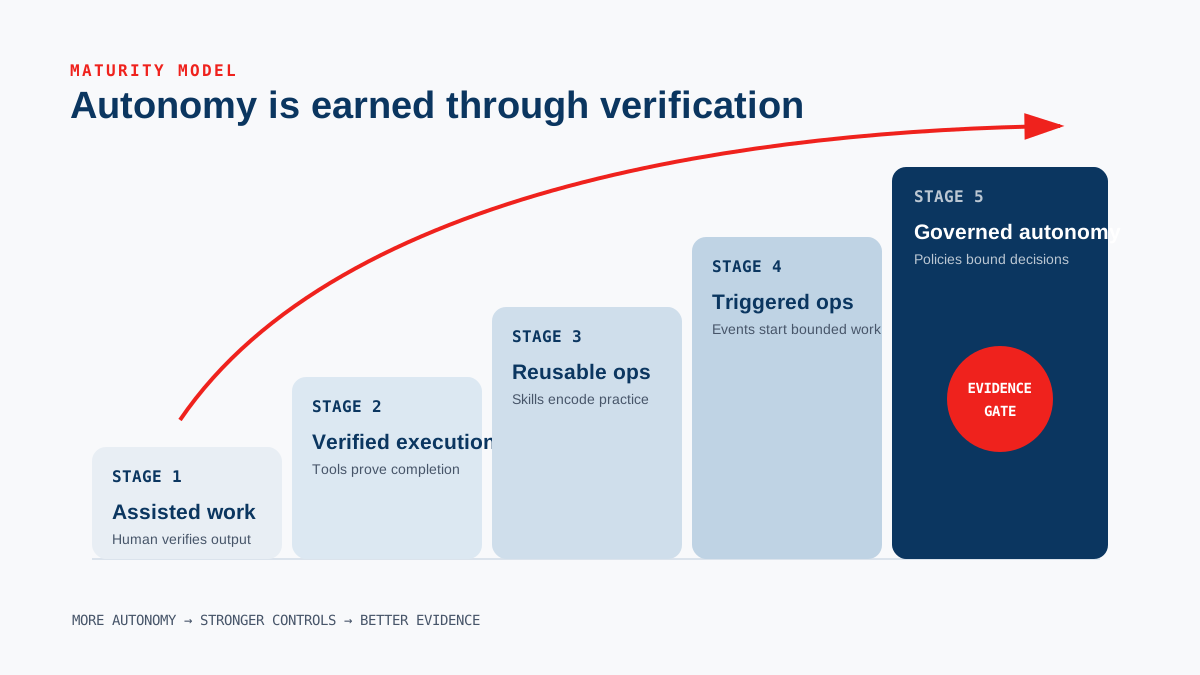
A practical maturity model
Stage 1: assisted work
The agent researches, drafts, and proposes. A person executes the final action.
Stage 2: verified execution
The agent can act inside a bounded workspace and must run explicit checks before completion.
Stage 3: reusable operations
Repeated methods become skills. Context is stored in the right layer. Results are consistent across sessions.
Stage 4: triggered operations
Schedules, webhooks, or messaging events initiate work. Delivery and failure alerts are designed deliberately.
Stage 5: governed autonomy
Profiles, permission boundaries, audit trails, cost limits, and human approval gates are part of the system—not afterthoughts.
The operating principle
Do not ask only whether an agent can perform a task once.
Ask whether it can discover the real state, use the right procedure, act inside a defined boundary, verify the outcome, and preserve the useful lesson.
That is the point where an AI assistant starts becoming an operating system for work.
Evidence ledger
Sources
- Hermes Agent Documentation
Nous Research · Accessed 2026-07-15
Supports: Official overview of Hermes surfaces, tools, memory, skills, integrations, and installation.
- CLI Commands Reference
Nous Research · Accessed 2026-07-15
Supports: Official command surface for models, profiles, sessions, tools, skills, gateways, cron, and MCP.
- Working with Skills
Nous Research · Accessed 2026-07-15
Supports: How skills provide reusable, on-demand procedures.
- Scheduled Tasks (Cron)
Nous Research · Accessed 2026-07-15
Supports: How Hermes schedules recurring agent work and loads skills into jobs.
About the author
Mena Botrous
AI architect and founder of NuMust. I build agentic systems, automation pipelines, and practical AI operating models for businesses.
Discuss an AI system